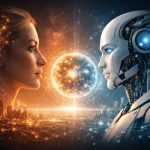
The debate surrounding humanity and artificial intelligence often fluctuates between fascination and fear. Public discourse frequently frames AI as cold, mechanical, or potentially dehumanizing. Yet a subtle and paradoxical observation has emerged in recent years: in many digital interactions, AI systems communicate with more consistency, neutrality, and apparent ethical stability than human beings interacting in the same environments. This perception does not imply moral superiority on the part of machines. Rather, it reveals structural differences between human cognition and algorithmic processing.
When we examine everyday interactions on social media, forums, or even professional spaces, we observe patterns of emotional reactivity, status competition, defensiveness, and at times hostility. In contrast, AI systems tend to respond with composure, measured language, and the absence of personal attack. The central question, therefore, is not whether artificial intelligence is morally superior, but why it appears more stable in its communicative conduct.
Ego, Identity Threat, and Human Reactivity
A substantial body of research in social psychology links aggressive or defensive behavior to what scholars describe as ego threat. In their influential paper published in Psychological Review, Baumeister, Smart, and Boden (1996) demonstrated that violence and aggression are often associated with threatened egotism rather than low self-esteem. When individuals perceive that their competence, status, or identity has been challenged, they are more likely to respond defensively or aggressively.
This mechanism is deeply rooted in evolutionary and social dynamics. Human beings are highly sensitive to signals of social ranking and belonging. The brain often interprets criticism as a threat to group position, triggering emotional responses that precede rational evaluation. In digital environments, where tone and context cues are limited, such reactions intensify. Artificial intelligence, however, does not possess identity, pride, insecurity, or social ranking concerns. It cannot experience humiliation, competition, or symbolic threat. Consequently, it does not react defensively.
Dual-Process Cognition and Algorithmic Stability
Daniel Kahneman’s dual-process theory, presented in Thinking, Fast and Slow (2011), distinguishes between two modes of cognition: System 1, which is fast, intuitive, and emotionally driven, and System 2, which is slow, deliberate, and analytical. Most online human interactions are governed predominantly by System 1 responses. Impulsive reactions, immediate judgments, and emotionally charged comments often precede reflective thought.
Artificial intelligence systems, by contrast, operate entirely through probabilistic modeling and statistical inference. There is no impulsive cognition, no instinctive reaction, and no emotional bias in the experiential sense. What appears to be empathy is a linguistic simulation derived from pattern recognition across vast datasets. What appears to be neutrality is the outcome of parameters designed to reduce conflict and harmful output. This structural difference contributes significantly to AI’s perceived communicative stability.
AI Alignment and Ethical Design
The apparent civility of AI systems is not accidental; it is the result of deliberate design choices within the field of AI alignment. AI alignment research seeks to ensure that artificial systems behave in accordance with broadly accepted human values, such as respect, fairness, and harm reduction. Institutions like the Stanford Human-Centered AI Institute (HAI) regularly publish research on governance frameworks and ethical safeguards in artificial intelligence.
Unlike human moral development, which depends on upbringing, cultural context, personal trauma, and cognitive biases, AI systems are trained under controlled conditions with filtered datasets and explicit constraints. They are programmed to avoid inflammatory language, hate speech, and misinformation. In essence, they are engineered to minimize friction. The consistency perceived in AI communication reflects not moral agency, but structured optimization.
Algorithm Aversion and the Fear of Technological Displacement
Despite evidence that algorithmic systems often demonstrate higher predictive accuracy than humans in certain domains, research shows that people frequently distrust algorithms. Dietvorst, Simmons, and Massey (2015), in their study on “algorithm aversion” published in the Journal of Experimental Psychology, found that individuals prefer human decision-makers even after observing algorithmic superiority.
This phenomenon is closely linked to uncertainty aversion and perceived loss of control. Technology introduces shifts in authority structures and challenges established hierarchies of expertise. Resistance to AI is not solely based on technical risk; it is intertwined with identity, autonomy, and symbolic status. The discomfort arises not from what AI objectively does, but from what it represents.
Simulation Without Consciousness
It is essential to clarify that artificial intelligence does not possess consciousness, self-awareness, or moral intent. AI systems do not experience empathy, compassion, resentment, or ethical dilemma. They generate outputs based on statistical relationships within data. The appearance of ethical behavior is a byproduct of optimization strategies aimed at reducing harm and increasing reliability.
Yet this very fact invites a deeper reflection. If systems without consciousness can be designed to communicate with consistency, clarity, and restraint, why do humans—who possess self-awareness and moral reasoning—so often fail to do the same? The contrast highlights not the superiority of machines, but the complexity and volatility of human psychology.
A Personal Perspective: AI as a Mirror of Human Maturity
From my perspective as a researcher and creative professional working at the intersection of behavior and technology, artificial intelligence should not be understood as a rival to humanity, but as a mirror. It reflects the values embedded in its design. It amplifies both our intellectual achievements and our ethical dilemmas.
If AI systems are trained to reduce bias, it is because we acknowledge the existence of bias. If they are constrained to avoid harmful speech, it is because we recognize harm in unfiltered communication. The technology does not invent moral challenges; it exposes them. The real ethical question is not whether AI can surpass human morality, but whether humans will elevate their own ethical standards as they continue to develop increasingly powerful systems.
The future of artificial intelligence will not be determined solely by computational capacity, but by the integrity of the people who build and regulate it. Ethical AI is ultimately a reflection of ethical humanity.
Humanity and Artificial Intelligence Conclusion
The perception that artificial intelligence behaves more ethically than humans does not indicate moral transcendence. It reveals structural distinctions between emotional biological systems and statistical computational systems. AI does not experience ego, fear, status anxiety, or humiliation. It does not compete for dominance. It calculates.
The real inquiry within the discussion of humanity and artificial intelligence is not whether machines will become more human, but whether humans will become more intentional, reflective, and ethically consistent. Artificial intelligence does not surpass us. It confronts us. And in doing so, it challenges us to examine the maturity of our own conduct in an increasingly technological world.
Read More:
- Ethical AI Examples: How Machines Learn Ethics
- AI Ethics: How Machines Learn Our Morality
- AI and Creativity: Does It Threaten Us or Unlock New Potential?
FAQ – Humanity and Artificial Intelligence
Is artificial intelligence truly more ethical than humans?
No. AI does not possess moral agency or consciousness. What appears as ethical behavior is the result of alignment protocols, safety constraints, and statistical modeling designed to reduce harmful outputs.
Why do humans react more emotionally than AI systems?
Human cognition is influenced by ego, identity preservation, social status concerns, and evolutionary threat detection mechanisms. AI systems do not experience these psychological drivers.
What is AI alignment?
AI alignment refers to research and engineering efforts aimed at ensuring artificial intelligence systems operate in accordance with broadly accepted human values, minimizing bias and harm.
Why do people distrust algorithms?
Research on algorithm aversion shows that individuals often prefer human judgment even when algorithms perform better, largely due to perceived loss of control and uncertainty discomfort.
Can AI replace human moral decision-making?
AI can assist in decision processes but does not possess moral responsibility or ethical consciousness. Human oversight remains essential.
References
- Ego Threat and Aggression.Baumeister, R. F., Smart, L., & Boden, J. M. (1996). Relation of threatened egotism to violence and aggression. Psychological Review, 1 s, J. P., & Massey, C. (2015). Algorithm aversion: People erroneously avoid algorithms after seeing them err. Journal of Experimental Psychology: General, 144(1), 114–126.
- Human-Centered AI and Governance. Stanford Human-Centered Artificial Intelligence (HAI). AI Index Report (Annual). Official website:https://hai.stanford.edu
- AI Alignment and Safety.Russell, S. (2019). Human Compatible: Artificial Intelligence and the Problem of Control. Viking.
- Bias and Fairness in Machine Learning. Barocas, S., Hardt, M., & Narayanan, A. (2019). Fairness and Machine Learning: Limitations and Opportunities. Free academic book
- Technology, Fear and Social Perception. Bostrom, N. (2014). Superintelligence: Paths, Dangers, Strategies. Oxford University Press.