Artificial intelligence is changing the creative world at a speed that feels both fascinating and uncomfortable. For artists, designers, writers, musicians and visual thinkers, AI is no longer a distant technological concept. It is already inside the studio, inside the browser, inside the brief, inside the moodboard and, in many cases, inside the anxiety of what it means to be creative today.
The conversation around AI and creativity is often reduced to two extreme positions. On one side, there are people saying that AI will replace artists, designers and creative professionals. On the other, there are people treating AI as a magical shortcut that can generate endless work without effort, authorship or responsibility. Both views are too simplistic. The more interesting truth lives somewhere in the middle.
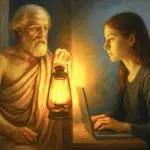
Generative AI can produce images, texts, music, videos and concepts in seconds. But speed is not the same as depth. Output is not the same as vision. A prompt is not automatically a creative identity. And a machine that can remix patterns is not the same thing as a human being who has lived, suffered, observed, questioned, loved, lost, remembered and transformed experience into meaning. AI can generate. But humans imagine. That difference matters.
What Does AI Mean for Creativity?
AI, in the creative context, usually refers to systems capable of generating or assisting with creative outputs: images, text, music, video, layouts, animation, ideas, scripts, visual references and even strategic concepts. These tools are trained on huge amounts of data and learn patterns from existing material.
This is why AI can feel impressive. It can imitate styles, combine references, suggest possibilities and accelerate production. It can help an artist explore visual directions, help a designer test compositions, help a writer structure ideas or help a musician experiment with atmosphere.
But this is also why AI raises ethical questions. If these systems learn from existing creative work, who owns the influence? Who benefits from the output? Who gets erased when a machine absorbs the visual language of thousands of creators without clear credit or compensation? This is where the conversation becomes serious. AI is not just a tool. It is also an economic, cultural and ethical force.
AI Can Produce Images, But Can It Create Meaning?
A machine can generate a beautiful image. That part is no longer shocking. The deeper question is: can it create meaning? Meaning is not only visual. It comes from context, intention, memory, contradiction and emotional charge. A painting is not powerful only because of its colors. A photograph is not moving only because of its composition. A poem is not alive only because the words are arranged well.
Human creativity is not just the act of making something. It is the act of making something matter. A human artist brings invisible material into the work: childhood, culture, grief, body, politics, spirituality, intuition, fear, desire, humour, resistance. These things cannot be reduced to pixels or prompt engineering. They can be imitated aesthetically, but not truly lived by the machine. This does not mean AI has no place in art. It means we need to stop confusing visual production with creative consciousness.
The Difference Between Tool and Author
One of the most important distinctions in the debate about AI and creativity is the difference between using AI as a tool and allowing AI to replace the creative act entirely.
Artists have always used tools. Brushes, cameras, software, tablets, synthesizers, editing programs, 3D engines and digital brushes have all expanded what creators can do. Technology has never been separate from art. The problem begins when the tool becomes opaque, extractive or falsely presented as the author.
When a human uses AI to test ideas, generate references, organize thoughts, build mockups or explore variations, AI can become part of the creative process. But when the human disappears entirely and the work is presented as if it came from lived artistic vision, something essential is lost.
The legal world is also paying attention to this distinction. Discussions around copyright increasingly focus on whether there is meaningful human authorship behind AI-assisted works. The central issue is not whether technology was used, but whether the final work reflects human creative control, judgment and originality.
For artists, this distinction is not just legal. It is existential.
Why Artists Feel Threatened by AI
The fear many artists feel is not irrational. It is not just resistance to change. It comes from real concerns.
First, there is the issue of consent. Many creators worry that their work has been used to train AI systems without permission, credit or payment. Second, there is the issue of market pressure. If clients believe AI can produce “good enough” visuals instantly and cheaply, they may undervalue human labour. Third, there is the issue of aesthetic flattening. If everyone uses the same tools trained on the same visual patterns, creative culture may become more repetitive, more polished and less alive.
There is also a psychological layer. Artists spend years developing their visual language. When a machine can imitate parts of that language in seconds, it can feel like a violation, even when the imitation is technically imperfect. This is why ethical AI in the arts cannot be treated as a small technical detail. It touches identity, livelihood, authorship and dignity.
The Creative Professional Is Not Dead — But the Role Is Changing
The rise of AI does not mean the end of creative professionals. But it does mean the role is changing. The future creative professional may need to become more than an executor. Execution alone is becoming easier to automate. What becomes more valuable is direction: taste, judgment, concept, narrative, ethical awareness, cultural reading and emotional intelligence.
In other words, the value moves from “I can make this image” to “I know what this image should mean, why it should exist, who it speaks to, what it evokes and what consequences it may have.” This is especially important for art directors, designers, illustrators and creative strategists. AI can generate options, but it does not understand a brand’s soul. It can produce visual noise, but it cannot always recognize what is culturally sensitive, emotionally precise or strategically wrong.
The human creative becomes the filter, the conductor, the interpreter. And honestly, that may be where the real power has always been.
AI as a Creative Mirror
One of the most interesting ways to use AI is not as a replacement, but as a mirror.
AI can reveal what we are drawn to. It can help us see patterns in our taste. It can externalize vague ideas quickly, allowing us to react, reject, refine and question. Sometimes, the most useful thing AI produces is not the final answer, but the wrong answer that helps us understand what we actually wanted.
For artists, this can be powerful. A generated image may show what feels too generic. A text suggestion may reveal what sounds artificial. A visual direction may help clarify what needs more humanity, more imperfection, more silence, more tension.
Used well, AI can speed up the rough stage of thinking. But it should not replace the deeper stage of feeling. The danger is becoming passive. If the artist only accepts what the machine gives, the creative process shrinks. If the artist argues with the machine, edits it, resists it, redirects it and transforms it, the process can remain alive.
The Problem With “AI Aesthetic”
AI-generated visuals often have a recognizable look: polished, cinematic, hyper-detailed, symmetrical, smooth, dramatic, sometimes strangely soulless. This is not always bad. But it can become a visual trap.
When everything looks impressive, nothing feels specific. Human art often becomes memorable because of its imperfections: the strange line, the unexpected colour, the awkward composition that somehow works, the emotional inconsistency, the handmade trace, the decision that would not appear in a dataset average.
The future of creativity may not belong to those who make the most perfect AI-generated image. It may belong to those who know how to bring friction back into the process. Texture matters. Mistakes matter. Personal mythology matters. Cultural roots matter. The human hand still matters, even when the final work is digital.
Ethical Creativity in the Age of AI
Using AI creatively requires more than technical skill. It requires ethics. A responsible creative process should ask:
- Who benefits from this work?
- What sources may have influenced this output?
- Am I being transparent about the role of AI?
- Am I replacing human labour where collaboration would be more ethical?
- Am I using AI to expand my own vision or to imitate someone else’s?
- Am I respecting the audience’s ability to understand how this work was made?
These questions do not kill creativity. They protect it. The creative world does not need to reject AI completely. But it also should not surrender to it blindly. The best path is not panic or worship. It is discernment.
Human Imagination Is More Than Productivity
One of the biggest risks of AI culture is the obsession with productivity. More images. More posts. More content. More versions. More speed. But creativity is not only about producing more.
Sometimes creativity requires silence. Sometimes it requires boredom. Sometimes it requires walking away from the screen. Sometimes it requires returning to the body, to paint, to paper, to conversation, to memory, to the uncomfortable question that cannot be solved by automation. AI can accelerate production, but it cannot replace the slow formation of a point of view. And in a world flooded with generated content, a real point of view may become the rarest creative asset.
The Future of AI and Creativity
The future of AI and creativity will probably not be a simple battle between humans and machines. It will be a negotiation. Some creators will reject AI completely. Some will use it heavily. Some will use it only for research, structure or experimentation. Some will build hybrid practices where traditional art, digital tools and generative systems coexist.
What matters is not only whether AI is used, but how and why it is used. The strongest creative voices will not be the ones who let AI define their imagination. They will be the ones who use technology without abandoning authorship. They will understand that tools can expand the hand, but they should not replace the soul. AI may become part of the creative studio. But it should not become the artist.
Conclusion: AI Can Generate, But Humans Give Form to Meaning
The debate about AI and creativity is not really about whether machines can make beautiful things. They already can. The real question is whether beauty without lived meaning is enough.
Human creativity is not only pattern-making. It is interpretation. It is memory turned into form. It is emotion organized into language. It is culture, instinct, doubt and desire becoming visible. AI can help us produce. It can help us explore. It can even surprise us. But it does not carry the burden and miracle of being human. That remains ours. And maybe, in the age of generative AI, the most radical creative act is not to produce faster, but to create with more consciousness.
Read more:
- AI Intelligence: What Makes an AI Seem Intelligent?
- What Is Creativity and How to Be Creative: Science and Tips
- Characteristics of Creatives: Different Soluctions To a Problem
Frequently Asked Questions
Can AI replace human creativity?
AI can automate parts of the creative process, but it does not replace human imagination, lived experience, emotional judgment or cultural meaning. It can generate outputs, but humans still define intention, context and value.
Is AI art real art?
AI-generated work can be part of an artistic process when there is meaningful human direction, editing and authorship. The debate becomes more complex when AI is used to generate work with little or no human creative involvement.
How can artists use AI ethically?
Artists can use AI ethically by being transparent, avoiding imitation of living artists without consent, respecting copyright concerns, using AI as a tool rather than a substitute for authorship and keeping human judgment central to the process.
Why are artists worried about generative AI?
Artists are concerned about copyright, consent, lack of credit, loss of income, imitation of personal styles and the possibility that clients may undervalue human creative labour.
What is the future of creativity with AI?
The future will likely be hybrid. Some artists will reject AI, while others will use it as part of their process. The strongest creative work will still depend on human vision, ethics, taste and emotional depth.
References
-
- UNESCO. (2025). Creators face projected global revenue losses of up to 24% by 2028, new UNESCO report shows. https://www.unesco.org/en/articles/creators-face-projected-global-revenue-losses-24-2028-new-unesco-report-shows
- WIPO. (n.d.). Artificial Intelligence and Intellectual Property. https://www.wipo.int/en/web/frontier-technologies/artificial-intelligence/index
- WIPO. (n.d.). Generative AI: Navigating Intellectual Property. https://www.wipo.int/documents/d/frontier-technologies/docs-en-pdf-generative-ai-factsheet.pdf
- WIPO Magazine. (2025). US Copyright Office on AI: Human creativity still matters legally. https://www.wipo.int/en/web/wipo-magazine/articles/us-copyright-office-on-ai-human-creativity-still-matters-legally-73696
- U.S. Copyright Office. (n.d.). Copyright and Artificial Intelligence. https://www.copyright.gov/ai/
- U.S. Copyright Office. (2025). Copyright and Artificial Intelligence, Part 2: Copyrightability. https://www.copyright.gov/ai/Copyright-and-Artificial-Intelligence-Part-2-Copyrightability-Report.pdf
- OECD. (n.d.). OECD AI Principles. https://www.oecd.org/en/topics/sub-issues/ai-principles.html
- OECD.AI. (n.d.). OECD AI Principles Overview. https://oecd.ai/en/ai-principles
- Reuters. (2025). US appeals court rejects copyrights for AI-generated art lacking “human” creator. https://www.reuters.com/world/us/us-appeals-court-rejects-copyrights-ai-generated-art-lacking-human-creator-2025-03-18/